

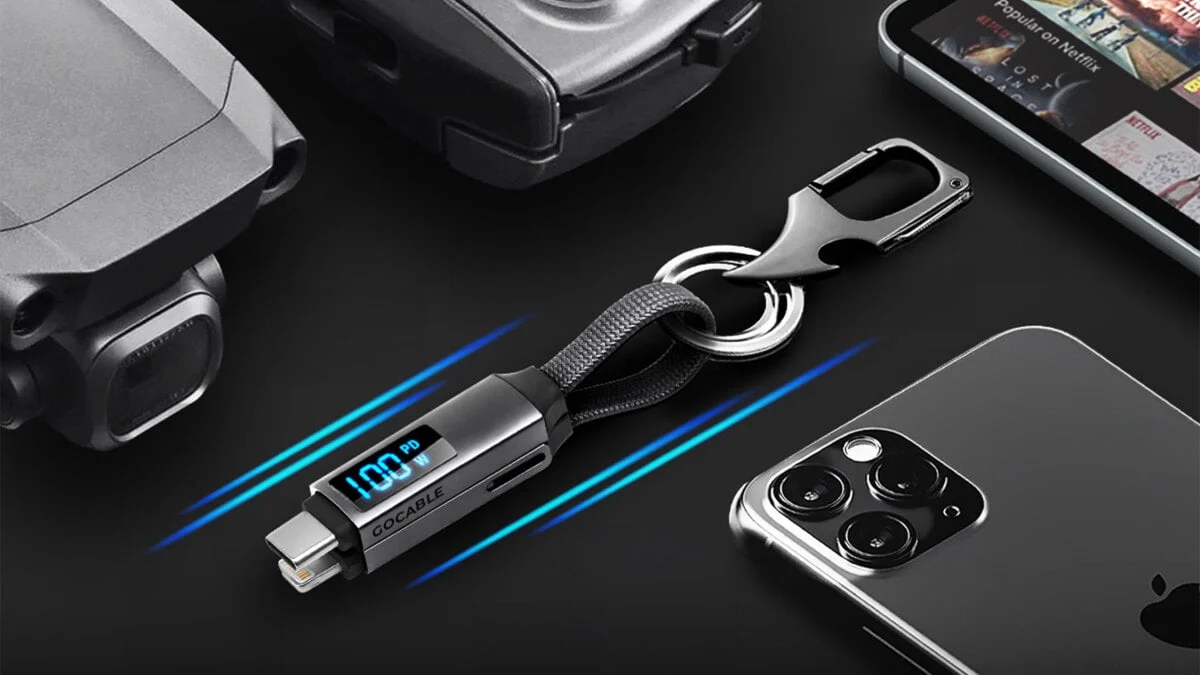
The GoCable 8-in-1 Every Day Carry (EDC) charger has entered the consumer electronics market as a specialized solution for the growing problem of cable fragmentation, offering a versatile charging interface currently priced at a discounted rate of $29.99. This represents a significant reduction from its standard retail price of $49.99, positioning the device as a competitive entry in the premium accessory sector. Designed to consolidate the various charging requirements of modern mobile ecosystems, the GoCable serves as a bridge between legacy hardware and the latest high-performance devices, integrating high-wattage power delivery with a suite of physical utility tools.
As the consumer electronics industry continues to navigate the transition between proprietary connectors and universal standards, the demand for "all-in-one" solutions has intensified. The GoCable addresses this by providing a compact, 5.9-inch form factor that clips onto keyrings or bags, ensuring that users are never without a power connection. This product launch and subsequent price adjustment come at a time when consumers are increasingly looking to streamline their mobile kits without sacrificing the high-speed charging capabilities required by modern laptops and tablets.
Technical Specifications and Power Delivery Capabilities
The core utility of the GoCable lies in its 100W Power Delivery (PD) capability. While many compact or multi-purpose cables are limited to lower wattages—often capping at 15W or 20W—the GoCable is engineered to handle the high-current demands of power-hungry devices. When paired with a compatible high-output wall adapter or power bank, the cable is capable of charging professional-grade laptops, including the MacBook Pro and high-end Windows ultrabooks, which typically require 60W to 96W for optimal performance.
Beyond laptop support, the 100W ceiling ensures that smartphones equipped with rapid-charge technologies can utilize their maximum intake speeds. The 8-in-1 architecture refers to the various permutations of connectors available on the device. By utilizing a series of integrated adapters, the cable can transition between USB-C, Lightning, and USB-A inputs and outputs. This versatility is critical in a landscape where a user might need to charge an iPhone 14 (Lightning) from a USB-A port in an airport, or an iPhone 15 (USB-C) from a modern USB-C power brick.
A distinguishing technical feature of the GoCable is its integrated LED power display. In an era where "phantom charging" or slow charging due to incompatible bricks is a common frustration, the real-time display provides users with immediate feedback on the wattage being delivered to their device. This transparency allows users to diagnose whether their power source is underperforming or if the device has reached its "trickle charge" phase as the battery nears full capacity.
The Evolution of Every Day Carry (EDC) Culture
The GoCable’s design philosophy is rooted in the "Every Day Carry" (EDC) movement, a subculture and consumer trend focused on high-utility, minimalist tools that can be carried on one’s person at all times. The EDC market has seen exponential growth over the last decade, shifting from tactical and outdoor gear into the mainstream tech space. The modern professional’s EDC kit now prioritizes digital connectivity alongside traditional tools.
To meet the demands of this demographic, the GoCable incorporates a magnetic wrap system. This design choice ensures that the cable remains tangle-free and maintains its compact shape when not in use. The inclusion of a keyring clip facilitates immediate access, reflecting a shift away from the traditional "cable in a backpack" model toward "on-person" utility.
Furthermore, the GoCable integrates secondary physical tools that extend its utility beyond electronics. It features a built-in bottle opener and a "safe-proof" cutter. The latter is designed for low-risk tasks such as opening shipping packages or cutting twine, appealing to the "preparedness" aspect of the EDC community. By combining digital power with physical utility, the manufacturer aims to replace multiple items in a user’s pocket with a single, 5.9-inch device.
Chronology of Charging Standards and Regulatory Context
The release and promotion of the GoCable 8-in-1 occur during a pivotal moment in global technology regulation. The European Union’s mandate for a common charging port (USB-C) has forced a massive shift in hardware design, most notably seen in Apple’s transition from Lightning to USB-C with the iPhone 15 series. However, this transition has created a "legacy gap" where millions of users still possess Lightning-based peripherals (AirPods, older iPads, and iPhones) while simultaneously adopting USB-C hardware.
The timeline of this transition highlights the GoCable’s market relevance:
- 2012: Apple introduces the Lightning connector, creating a proprietary ecosystem.
- 2014: The USB-C specification is finalized, promising a universal, high-speed standard.
- 2021-2023: Regulatory bodies in Europe and India pass laws requiring USB-C as the standard for small electronics.
- 2023-2024: The market enters a "hybrid phase" where consumers require both Lightning and USB-C support daily.
By offering an 8-in-1 solution, the GoCable acts as a temporary but necessary bridge during this multi-year transition period. It allows users to maintain their existing hardware investments while remaining compatible with the new universal standard.
Market Analysis and Consumer Implications
Industry analysts suggest that the "cable fatigue" experienced by consumers is a driving force behind the success of multi-functional accessories. The average household now contains between five and ten different types of electronic devices, often requiring a mix of micro-USB (for older accessories), Lightning, and USB-C.
The GoCable’s $29.99 price point is positioned to compete with high-end single-purpose cables from brands like Belkin or Apple, which often retail for $19.00 to $35.00 without the added benefits of multi-connector support or 100W ratings. From a value-proposition standpoint, the GoCable offers a lower "per-function" cost than purchasing individual cables for a laptop, a phone, and a tablet.
There is also an environmental dimension to the adoption of multi-cables. The reduction of e-waste is a significant concern for both regulators and environmentally conscious consumers. By using one durable, multi-purpose cable instead of three or four cheaper, disposable ones, consumers can theoretically reduce their environmental footprint. The GoCable’s focus on durability—highlighted by its tangle-free design and robust housing—suggests a longer lifecycle than standard rubber-clad cables provided by device manufacturers.
Broader Impact on Mobile Productivity
The implications of the GoCable extend into the realm of mobile productivity and the "digital nomad" lifestyle. As more professionals move toward remote work and travel-heavy schedules, the weight and volume of tech gear become critical factors. The ability to charge a drone, a camera, a laptop, and a smartphone using a single keyring-mounted device represents a significant optimization of mobile workflows.
The 100W capability is particularly transformative for field professionals. Photographers and videographers, for instance, can utilize the GoCable to top off camera batteries or power external monitors via USB-C PD, while still having the flexibility to charge a client’s iPhone via the Lightning adapter. The LED display serves as a professional diagnostic tool in these scenarios, ensuring that power delivery is consistent and sufficient for the hardware in use.
Official Responses and Safety Standards
While specific statements from the manufacturer regarding the current sale were not released, the tech accessory industry generally views these promotional periods as a means to capture market share during peak travel seasons. Industry experts emphasize that when purchasing multi-function cables, consumers should look for adherence to safety standards such as CE and RoHS certifications, which ensure the device handles high-voltage throughput without risking fire or hardware damage.
The GoCable’s "safe-proof" cutter also reflects a growing trend in "TSA-friendly" tool design. By ensuring the cutting edge is shielded and designed for utility rather than as a weapon, the device maintains its status as a travel-ready accessory, a key requirement for the EDC market.
Conclusion and Future Outlook
The GoCable 8-in-1 EDC charger represents a convergence of three major trends: the move toward 100W universal power standards, the rise of the EDC minimalist aesthetic, and the logistical necessity of managing a hybrid ecosystem of connectors. At its current promotional price of $29.99, it offers a high-utility alternative to the standard cable clutter that has plagued the mobile era.
As the industry moves closer to a pure USB-C future, the need for adapters may eventually diminish. However, for the foreseeable future—estimated by analysts to be at least the next five to seven years—the "legacy gap" will remain a reality for the majority of global consumers. Tools like the GoCable are likely to remain essential components of the modern toolkit, providing the necessary versatility to keep an increasingly digital world powered and connected. The integration of physical tools and real-time data displays further cements its place as a sophisticated evolution of a once-simple peripheral.
